10th anniversary of KarnaughMap445
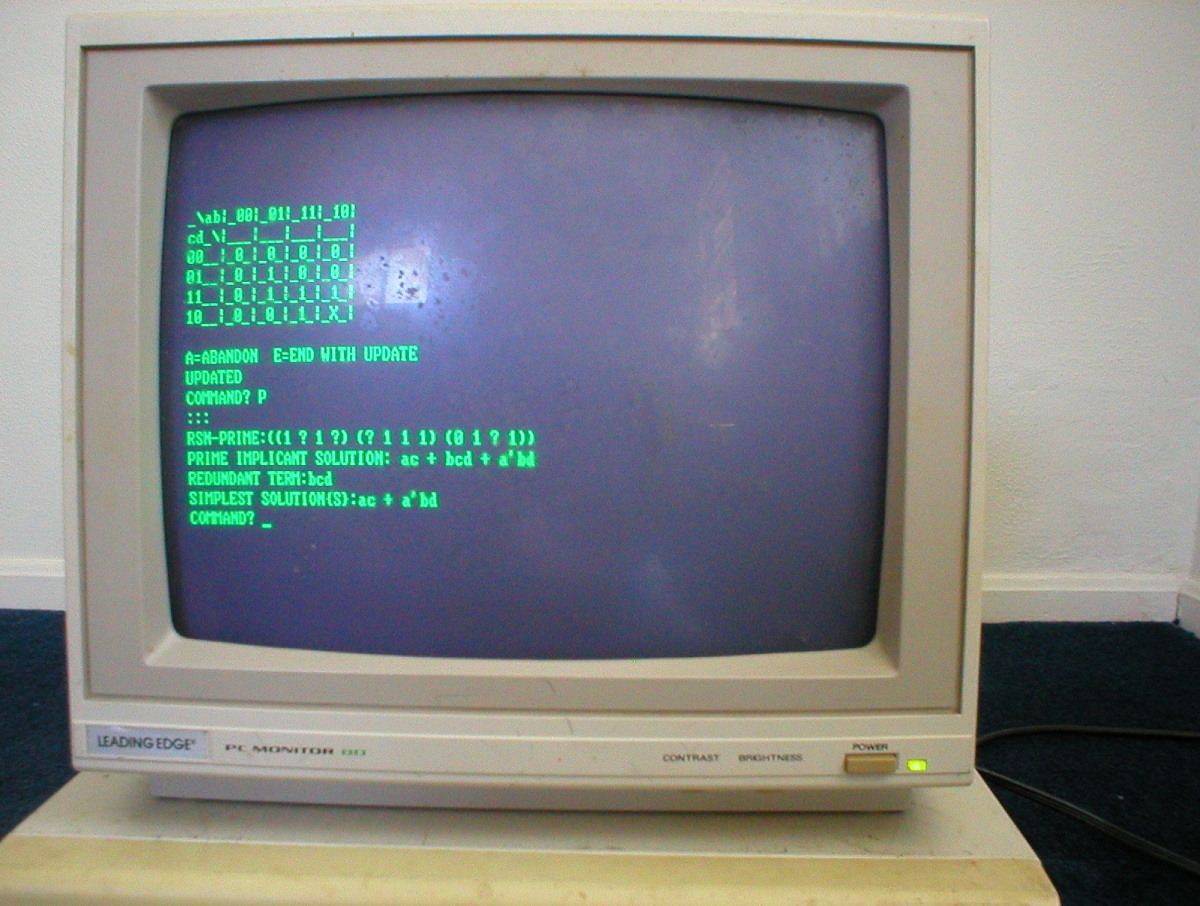
August 15, 2011 marks the 10th anniversary of my KarnaughMap445 program.
 Actually, the development of Kmap began 27 years ago in 1984 when I was taking
an AI class from Dr. David
Stoutemyer.
For my final project, I wrote a 4-variable Kmap editor/solver on a LISP interpreter called muLISP.
Actually, the development of Kmap began 27 years ago in 1984 when I was taking
an AI class from Dr. David
Stoutemyer.
For my final project, I wrote a 4-variable Kmap editor/solver on a LISP interpreter called muLISP.
Built upon CP/M first, and DOS later, the output of my program was ASCII text-based and the K-map and Truth-Table cursor movements emulated the Wordstar control keys. However, the program was quite complete in that it could handle don't-cares and remove redundant terms. Expression entry utilized a unique feature of LISP which said code and data were totally interchangeable. I first converted the infix into a prefix tree. Then I generated the minterms by assigning ones and zeros to the variables and calling the EVAL function.
On August 1, 1997, I set up my first web page to sell my puzzle shareware. That was when I started thinking about re-writing kmap to run on Windows. On October 11, 1998 I started the actual porting. As I was writing the program, I realized that computers were already fast enough to compute the prime implicants and draw ovals real-time.
On February 27, 1999 I released the first program in the world that allowed users to interactively enter a Karnaugh Map by clicking on cells with a mouse AND drew ovals real-time (kmap 1.1). On June 6, 1999, I released Kmap 1.2, the current free version.
On August 15, 2001, I added the ability to handle 5 variables and released KarnaughMap version 445 (kmap445.exe). I currently sell it as the "full" version. On June 30, 2011, Kmap445 passed Windows 7 certification.
In conclusion, I owe the concepts and algorithms to Maurice Karnaugh,
W. V. Quine, and Edward McClusky. But drawing ovals real-time is
uniquely mine. I would like to thank the approximately one
thousand customers who purchased the
"original" kmap program over the years.